Astrology as Sacred Science: How the Zodiac Was Used in Mystery Schools and Secret Traditions
- Bex

- Feb 3
- 6 min read
Astrology did not begin as personality typing, lifestyle guidance, or entertainment. In its earliest and most influential forms, astrology functioned as a sacred cosmological language, used to describe the structure of the universe, the rhythm of time, and the evolution of consciousness itself.
Across history, the zodiac appears repeatedly in mystery schools, philosophical traditions, temple cultures, and initiatory societies. It was not used to define identity in the modern sense, but to teach alignment with cosmic order. Understanding this older function of astrology helps explain why the zodiac has been preserved so carefully through symbolism, ritual, and encoded teachings rather than open instruction.
To truly understand astrology’s depth, we must step back into the world of sacred science, where knowledge was experienced, embodied, and gradually revealed. Now...this is a basic overview. To understand this topic in such depth requires a lot of books and researching, I am trying to just take away key points for you (and hopefully spark an interest that takes you into a bigger wormhole, please ask me for book recommendations!)
Astrology Before Horoscopes
In ancient traditions, astrology was not concerned with describing personality traits or predicting events. It was concerned with understanding order. The zodiac represented a fixed pattern through which time, nature, and consciousness moved in harmony.

Rather than asking who a person was, astrology asked how the universe functioned and how the individual might align themselves with that greater rhythm. This is why astrology was often taught through symbol, myth, geometry, and ritual rather than explanation alone. It was not meant to be consumed quickly, but contemplated deeply.
This cosmological understanding of astrology forms the foundation of every mystery tradition that followed.
Plato and the Ordered Cosmos
In the philosophical traditions that shaped Western esoteric thought, particularly those influenced by Plato, the universe was understood as an intelligent and ordered system governed by harmony, proportion, and intelligible design. Reality was not chaotic or accidental, but structured according to eternal principles that the human mind could gradually learn to recognise.
Within this worldview, astrology naturally became a spiritual discipline rather than a predictive tool. The movements of the heavens reflected patterns of truth, and studying them was a way of aligning the soul with higher reality. Learning, in this sense, was not about acquiring information but remembering truths the soul already knew.
This Platonic approach deeply influenced later mystery schools by framing astrology as a path of awakening rather than superstition.
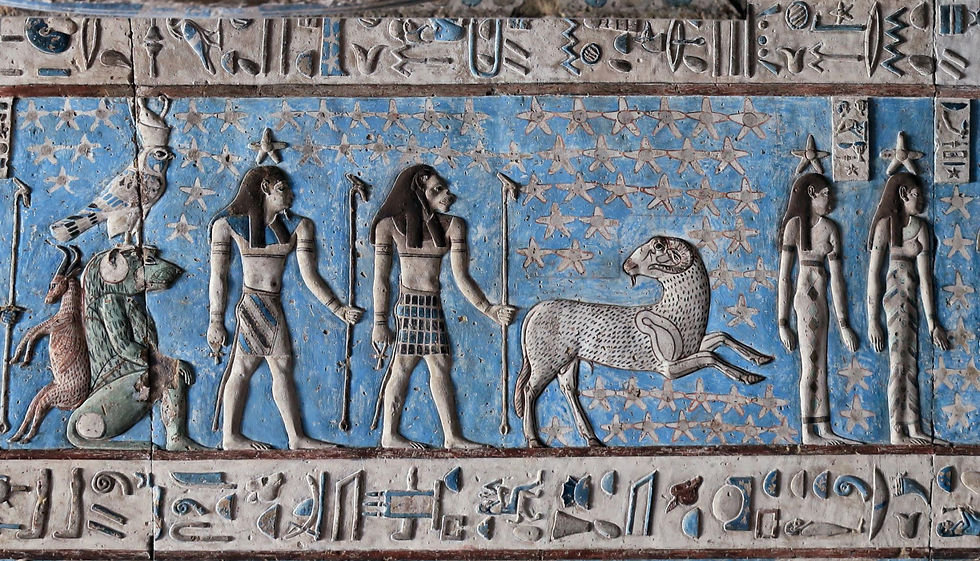
Egyptian Temple Astrology and Cosmic Authority
Ancient Egypt treated the sky as sacred authority. The stars were not distant objects but living principles woven into religion, governance, architecture, and ritual life. Temples were aligned with celestial movements, and the study of the heavens was reserved for priesthoods who understood astrology as a means of maintaining cosmic balance.
In this context, astrology was inseparable from spiritual responsibility. To understand celestial order was to understand life, death, rebirth, and divine law. Knowledge of the zodiac was therefore initiatory rather than public, revealed gradually through ritual participation rather than intellectual study alone.
This temple-based understanding of astrology established a pattern that would repeat across history, where cosmic knowledge was protected not to exclude, but to preserve its transformative power.
Greek Mystery Schools and the Soul’s Descent and Return
As Egyptian knowledge passed into the Greek world, astrology became woven into initiatory traditions concerned with transformation rather than belief. Greek mystery schools taught that the soul moved through cycles of descent into matter and return through remembrance and awakening.
Within these traditions, the zodiac symbolised stages of experience rather than fixed identity. It mapped the soul’s journey through time, embodiment, challenge, and eventual reintegration with higher order. Astrology was not something one studied at a distance, but something one lived through participation in sacred rites.
This understanding positioned the zodiac as a map of process rather than personality, a symbolic ladder through which consciousness evolves.
Hermetic Philosophy and the Language of Correspondence
Hermetic traditions refined astrology into a precise symbolic language based on correspondence, proportion, and reflection. The universe was understood as layered and patterned, with each level mirroring the others. Celestial movements corresponded to spiritual principles, and the human being was seen as a microcosm of the greater cosmos.

Astrology, within this framework, became a grammar for understanding how universal order expresses itself through form. Signs and planets were not literal forces acting upon humanity, but symbolic expressions of intelligible patterns. To read the stars was to read the structure of reality itself.
This approach laid the groundwork for later esoteric systems that preserved astrology through symbolic encoding rather than direct teaching.
Marie Louise Clemens and the Athena Astrological Society
In the early twentieth century, Marie Louise Clemens carried forward this initiatory approach to astrology through her work with the Athena Astrological Society (the inspiration behind my own 'not so secret' society). Her teachings treated astrology as a system for inner development rather than a tool for prediction or entertainment.
Clemens emphasised correspondence, symbolism, and structured contemplation, encouraging students to work with astrology as a means of refining perception and understanding cosmic order. Astrology, in her approach, trained the mind to recognise pattern, proportion, and alignment rather than focusing solely on events or identity.
This lineage reflects a continuation of mystery school astrology, where learning unfolds gradually through symbolic engagement rather than instant interpretation. Astrology becomes a discipline of awareness, not a shortcut to answers.
Rosicrucian Thought and Encoded Wisdom
During the Renaissance and early modern period, Hermetic and Platonic ideas resurfaced through Rosicrucian philosophy, alchemy, sacred geometry, and symbolic teaching systems. Astrology within these traditions functioned as encoded wisdom, preserved through diagrams, allegory, and ritual structure rather than open explanation.
The zodiac became a mandala of cosmic order, a visual and symbolic representation of spiritual transformation. Meaning was layered, requiring contemplation and experience to unfold fully. Astrology was not hidden, but veiled, ensuring that its deeper significance remained intact across generations.
Symbol, rather than instruction, became the vessel through which sacred science survived.
Manly P. Hall and Astrology as Initiatory Knowledge
Manly P. Hall articulated this initiatory understanding of astrology with remarkable clarity. He consistently framed the cosmos itself as a symbolic temple, structured according to universal law, proportion, and order. Within this vision, the zodiac functions as an architectural framework of reality rather than a personality system.

Hall described astrology as part of a broader symbolic philosophy that included Hermeticism, Qabbalah, Rosicrucianism, and Freemasonry. In his work, the zodiac appears as an ordered system through which consciousness moves, a pattern against which the initiate is measured rather than a chart to be interpreted casually.
This distinction is essential. Astrology, in Hall’s view, is not information to be collected, but a structure to be entered. Understanding arises through alignment rather than analysis.
Freemasonry and the Zodiac as Cosmic Framework
Freemasonry inherited this symbolic cosmology and preserved it through ritual, architecture, and ceremonial design. In Masonic imagery, the lodge itself represents the world, symbolically covered by the heavens. The zodiac often appears above the initiate, emphasising cosmic order rather than individual identity.

This placement conveys a clear initiatory message. The individual does not command the cosmos, but learns to align with it. Initiation involves submitting the personal self to universal law and recognising one’s place within a larger structure.
Astrology within Freemasonry is therefore experiential and symbolic, not instructional. Meaning unfolds through participation rather than explanation.
Why Astrology Was Preserved Through Symbol
Mystery traditions did not protect astrology because it was dangerous or forbidden, but because its power depends on experience rather than information. When symbolic knowledge is reduced to explanation alone, it loses its ability to transform consciousness.
Symbol allows wisdom to remain alive across centuries, cultures, and belief systems. It invites engagement, contemplation, and gradual understanding. Astrology, when preserved symbolically, remains a living language rather than a static system.
Astrology Beyond Modern Interpretation
Modern astrology offers valuable insight into identity, psychology, and emotional awareness. However, when viewed through the lens of mystery traditions, it becomes clear that astrology was never intended to stop there.
The zodiac originated as sacred science, a system for understanding cosmic order, spiritual development, and the unfolding of consciousness through time. It was designed to orient the soul within a living universe rather than describe personality traits.
This deeper lineage explains why astrology continues to resonate so powerfully. Beneath the modern language lies an ancient structure that still speaks to something timeless within us.
Astrology was never small, it was sacred science.


Comments